

















Since Milton Hershey sold the first HERSHEY’S Milk Chocolate bar in 1900, we’ve been all about learning the art—and the science—of chocolate. We’re proud to combine our love of sweets and snacks with incredible science, and you can too, at home or in the classroom. Dive into these fun facts and hands-on experiments to become a true chocolate expert.
Chocolate Science Projects, Tricks and Activities
One of the best ways to learn is by doing, and what could be more fun than learning with chocolate? Check out our activity ideas below to create a truly memorable learning experience for your students and kids. After all, who says studying can’t be sweet?

From Cacao to Cocoa: Where Chocolate Begins
If you have had the chance to ride on our HERSHEY’S Chocolate Tour Ride in Hershey, PA, you may already know that the cacao pod is where the magic of chocolate making begins. While we encourage everyone to visit our ride at Chocolate World, we’re excited to share this knowledge so you can explore and learn from home.
For a simple yet interactive lesson, learn the parts of a cacao tree by building one with a variety of snacks. Using our provided template, you can create an educational—and delicious—model of the tree. This activity can also be adapted into a coloring sheet or word match!
- Concept: Learn the parts of a cacao tree
- Activity: Use various snacks to create a replica of the cacao tree.
- Lesson: A cacao tree consists of its trunk, branches, leaves, roots and cacao pods; a cacao pod is at the very start of making chocolate.

Radiant and Thermal Energy: Making S’mores with a DIY Solar Oven
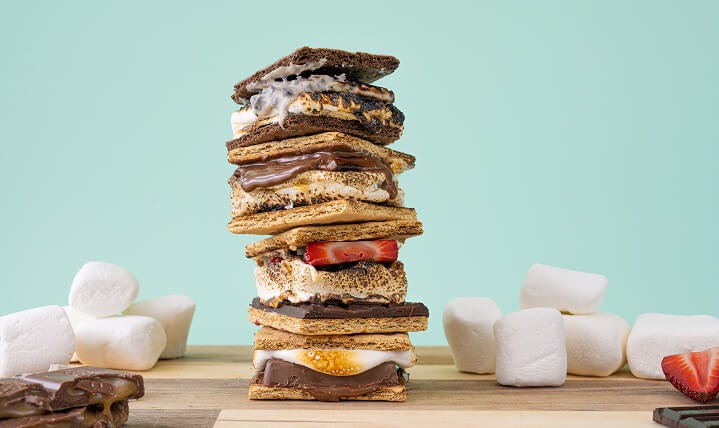
For a uniquely delicious solar oven science project, try building your own solar oven for S’mores. Students can explore how radiant energy from the sun transforms into thermal energy, melting chocolate and marshmallows into the perfect ooey gooey S’more. A science project that smells great!
- Concept: Trapping radiant heat and using it for heating
- Activity: Make a DIY solar oven using materials around from the house, add a thermometer inside, assemble s’mores ingredients, and watch how solar heat converted to thermal heat melts the HERSHEY’S chocolate bar and marshmallow s’more.
- Lesson: Radiant energy from the sun is trapped and converted into thermal energy.

Hydrophobic vs Hydrophilic: Cocoa in Water Trick
This surprising yet straightforward activity requires only two ingredients but comes with a wow factor. By sprinkling dry cocoa powder over a bowl of water, students will see that the cocoa resists sinking because it is hydrophobic. Even when they poke the surface, the cocoa stays put. It’s not until you stir vigorously that you can break the surface tension and create a mixture.
- Concept: Water tension and molecular properties
- Activity: Sprinkle dry cocoa powder over a bowl of water and try to poke your finger through. The cocoa resists sinking because it is hydrophobic (repels water). Then stir it vigorously to break surface tension.
- Lesson: Discover the hydrophobic property of cocoa powder.

Soil Horizons: The Different Soil Layers in Earth’s Crust
The Hershey Dirt Cup comes complete with JOLLY RANCHER “gems” and TWIZZLERS PULL ‘N’ PEEL “wiggly worms.” This activity doubles as a learning lesson and a sweet treat, whether you are in the classroom or at home. Follow our simple instructions to create a pudding and cookie “dirt cup” that illustrates the layers of soil making up Earth’s crust. This is also a neat way to enjoy several of our different Hershey’s candies in one bite!
- Concept: Craft demonstrating the layers of soil Earth’s crust using dirt cups
- Activity: Layer ingredients representing the different layers of soil into clear cups.
- Lesson: Learn the 7 layers of Earth’s crust.

Viscosity of Chocolate: Chocolate Lava Flow
Did someone say chocolate lava? As experts on this topic, we have an activity idea for you. To demonstrate how lava flows from volcanoes, students can observe how melted chocolate chips flow across different surfaces. Try pouring the melted chocolate onto foil, wax paper, or even an unfrosted cake, and watch how it flows around obstacles before cooling into a solid.
Real lava’s viscosity allows it to flow quickly when liquid, but it eventually cools into a solid. Just like real lava, melted chocolate has viscosity. The more you know!
- Concept: How lava flows in volcanoes
- Activity: Melt chocolate chips and pour over different surfaces (foil, cake, wax paper, etc.). Observe how it flows around obstacles and eventually cools into a solid (like lava transforms from a liquid to solid).
- Lesson: Real lava will flow quickly when a liquid based on its viscosity but cool into a solid.

Molecular Expansion: Marshmallows Under Heat
Perhaps you have made a microwave S’more in your lifetime, but did you know there is a valuable science lesson to be learned? Microwaving a marshmallow on a plate for 10-15 seconds is an excellent demonstration of thermal expansion. Heating the marshmallow makes the air molecules inside expand fast, making for your fluffy, gooey, extra sticky marshmallow.
For the perfect microwave-made S’more, be sure to check out our official tutorial!
- Concept: Air expansion under heat
- Activity: Microwave a marshmallow on a plate for 10–15 seconds and watch it expand! Then let it cool and shrink back down.
- Lesson: Heat makes air molecules inside the marshmallow expand, demonstrating thermal expansion.
Fun HERSHEY’S Chocolate Facts

More than 80 million HERSHEY’S KISSES candies are produced per day—the very first HERSHEY’S KISSES chocolates were produced in 1907.

We produce at least 25 million REESE’S Cups every day—did you know that there are more than 100 different REESE’S product varieties?

Around 7 million metric tons of chocolate are consumed around the world each year—and that is only an estimate!
Chocolate Solubility Pop Quiz: Mixtures vs. Solutions
Looking for a delicious way to test your students’ baking science knowledge? Try serving up a quiz! Challenge them to answer whether certain fan-favorite dessert and drink items are mixtures or solutions. It’s a fun and engaging way to reinforce what they have learned.
As a reminder, a mixture is when two or more substances are combined, but each one keeps its own properties. The items are physically combined, but they can still be separated. In a solution, one substance is dissolved into another, and this cannot be undone.
Check out our sample questions below for some inspiration!

Examples:
Is Hot Chocolate a Mixture or a Solution?
Answer: Mixture (dry) and solution (dissolved)!
- When you mix cocoa powder and sugar, you have a mixture because the ingredients are not dissolved into one another and can still be separated. But once you mix those ingredients with hot milk or water, the particles dissolve into the liquid. This forms a homogeneous solution—in this case, hot chocolate! A solution is a type of mixture where the solute (cocoa and sugar) dissolves completely into the solvent (milk or water), making it look uniform.
Milk and Chocolate Syrup; Mixture or Solution?
Answer: Solution!
- While milk and chocolate syrup are both liquids, they have different densities. Syrup has a higher density which is why it sinks to the bottom of the glass without separating, but once the syrup dissolves and distributes evenly, it becomes a homogeneous mixture—chocolate milk!
Is Chocolate Chip Cookie Dough a Mixture or a Solution?
Answer: Mixture!
- This is a mixture because you can still see and separate the different ingredients, such as flour, sugar, butter, eggs, and chocolate chips. Since the components don’t completely blend into one another, this is considered a heterogeneous mixture. Freshly baked chocolate chip cookies on the brain now? Check out our recipe.
Is Chocolate Cake a Mixture or a Solution?
Answer: Mixture!
- When you mix ingredients like flour, sugar, cocoa powder, eggs, butter, and milk, you are combining different substances that don’t fully dissolve into each other.
- Some ingredients, like sugar in milk, dissolve partially, but the overall batter remains a heterogeneous mixture because you can still distinguish different components (especially before mixing thoroughly).
- When the batter is baked, a chemical change occurs. The heat causes ingredients to react, making the cake rise and giving it a solid structure. Once baked, you can’t separate the original ingredients, making it a new substance, not just a mixture anymore.
- Check out our Old Fashioned Cake recipe for a timeless treat using HERSHEY’S Cocoa.
Is Chocolate Fondue a Mixture or a Solution?
Answer: Mixture / solution hybrid!
- If you melt pure chocolate and mix it with cream or oil, it forms a smooth, uniform consistency, making it a solution. However, if you dip fruit or cookies into the fondue, the entire dish becomes a heterogeneous mixture since the dipped items don’t dissolve into the chocolate.
Frequently Asked Questions
-
This is not a trick question, even though we imagine that chocolate makes you happy through taste alone. Chocolate has additional mood-boosting drivers, with compounds like theobromine, phenylethylamine and anandamide working together to stimulate the brain and elevate your mood. Is your list of chocolate science facts getting lengthy?
-
Chocolate bloom is a natural occurrence, triggered when fat or sugar crystals rise to the surface. While this chocolate is still safe to eat, you can avoid this by storing your chocolate in a cool, dry place. Either way, that classic sweet chocolate taste remains—so no need to worry!
-
We have great news—the flavanols in dark chocolate make this largely factual. With the power of antioxidants, dark chocolate with a high percentage of cacao content comes with perks. Reaping benefits like supporting heart health and improving your mood, we affirm that good things come from eating chocolate as part of a healthy, balanced diet.
-
When baking powder or baking soda reacts with an acidic ingredient like buttermilk or cocoa powder, carbon dioxide gas is produced. These bubbles of gas expand in the batter, making the cake fluffy and light. And delicious!
Eager for more kitchen chemistry? Check out the science of baking a cookie to see some cool overlaps.
Special Thanks to Milton Hershey School
The Hershey Company partnered with students at Milton Hershey School to learn some sweet lessons! When Milton and Catherine Hershey founded the school in 1909, they wanted to give children a chance to succeed through education and opportunity. That spirit lives on today, over a century later, with MHS serving nearly 2,200 students every year! Learn more about Milton Hershey School.